


Languages
- Español
- English
The UAB successfully concludes the MILID Summer School 2026
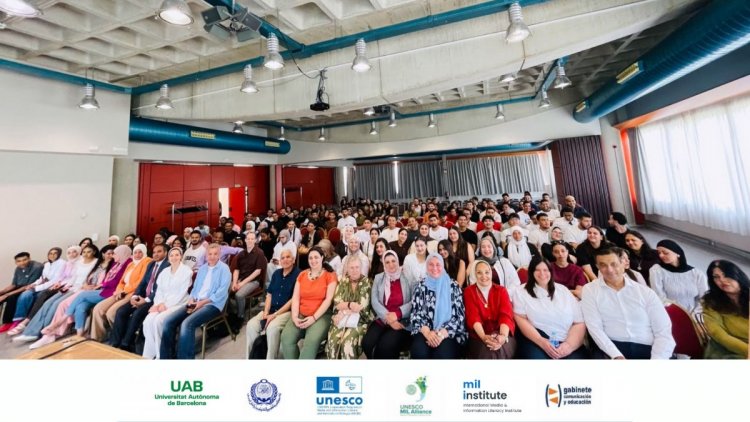
The Universitat Autònoma de Barcelona (UAB) has concluded a new edition of the MILID Summer School, an international programme organised by the UAB's Communication and Education Office in collaboration with the Arab Academy for Science, Technology and Maritime Transport (AASTMT), the UNESCO UNITWIN MILID Network, the UNESCO MIL Alliance and the MIL Institute.
The closing ceremony, held on Friday 17 July at the UAB Hotel Campus, brought together more than 300 students, researchers and academics from a dozen countries who had spent the previous two weeks taking part in an academic programme comprising keynote lectures, workshops, case studies and debates centred on three main thematic areas: MIL and Global Understanding, Law and Rights, and Challenges of Artificial Intelligence.
The ceremony featured addresses by the programme's Co-Director, Dr Cristina Pulido, the Arab Academy's Vice President, Dr Samy Tayie, and Dr María José Recoder, member of the Executive Board of the Col·legi de Periodistes de Catalunya (CPC). They reflected on the achievements of the MILID Summer School 2026 and highlighted the importance of consolidating this international platform for education, research and academic cooperation.
One of the central moments of the event was the presentation of the projects developed by students as part of the MIL Young Peace Ambassadors initiative. Participants showcased the awareness-raising campaigns and proposals they had produced throughout the Summer School, focusing on media and information literacy, intercultural dialogue and peacebuilding.
The session also included a presentation by doctoral researcher Nour Nfissi, who shared the main findings of the programme evaluation based on questionnaires completed by participants. The survey results revealed a high level of overall satisfaction while also gathering valuable feedback and recommendations to inform future editions of the programme.
Researcher María Farré also presented the latest developments concerning the MIL Magazine, a publication promoted by the UNESCO UNITWIN MILID Network with the aim of bringing research on media and information literacy to wider audiences and strengthening the transfer of scientific knowledge to society.
The ceremony was chaired by Professor Sally Tayie, Head of the Department of Journalism at the Arab Academy, who thanked the teaching staff and, in particular, all participants involved in this year's edition. She emphasised the importance of international cooperation in addressing the communication and societal challenges of today's rapidly changing world.
The 2026 edition took place from 7 to 17 July on the UAB campus, which became a meeting point where knowledge, international cooperation and cultural exchange laid the foundations for new initiatives aimed at fostering more democratic, inclusive and peaceful societies.
The Communication and Education Office is a consolidated research group specialising in scientific research and dissemination within the Department of Journalism and Communication Sciences at the Universitat Autònoma de Barcelona (UAB). Recognised by AGAUR (Agency for Management of University and Research Grants of the Government of Catalonia) as a Consolidated Research Group in recognition of its trajectory, impact and development, it carries out research projects at the intersection of communication and education. Since its foundation, the Gabinete has promoted numerous initiatives aimed at integrating communication technologies into the so-called global or knowledge society in a conscious, critical and responsible way. Under the direction of Santiago Tejedor, the Gabinete organises several UAB continuing education master's programmes, including the Master's Degree in Travel Journalism (on-campus and online), the Master's Degree in Communication and Education, the Master's Degree in Environmental Communication, and the Master's Degree in Political and Electoral Communication Management. The group has produced an extensive and continually expanding body of scientific publications, including journal articles, books, book chapters and other research outputs. It also hosts an innovation laboratory dedicated to educational projects, knowledge transfer and the development of new communication formats through creativity and multidisciplinary collaboration. Every year, the Office organises an international academic expedition bringing together students from different universities and disciplines through the Tahina-Can Expedition, recognised as Spain's best educational project. In addition, it develops educational initiatives such as the Tu Aventura portal, the InfoEDU educational platform and the science and newsgames project Reporteros de la Ciencia.