


Languages
- Español
- English
The UAB opens the MILID Summer School 2026 with an international call for media and information literacy and peacebuilding
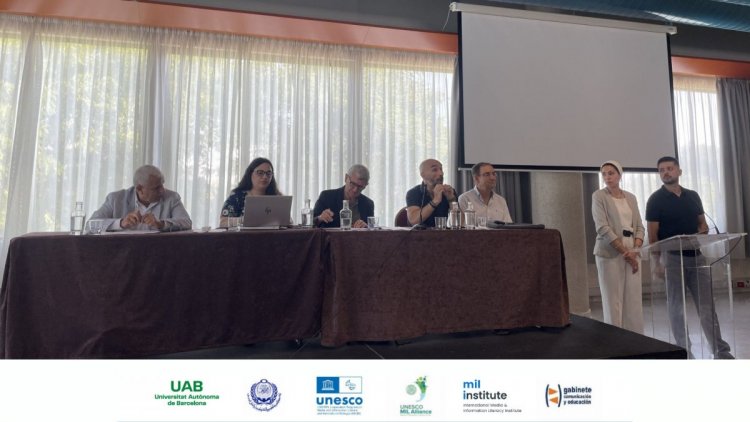
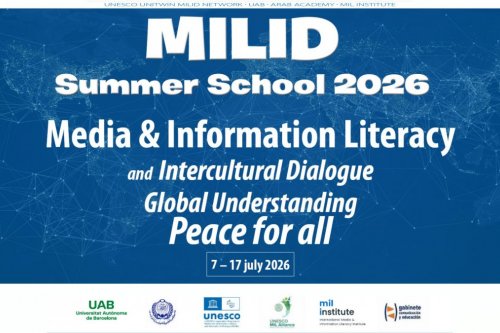
The Autonomous University of Barcelona (UAB) has officially opened a new edition of the MILID Summer School, an international programme organised by the UAB's Communication and Education Office in partnership with the Arab Academy for Science, Technology and Maritime Transport (AASTMT), the UNESCO UNITWIN MILID Network, the UNESCO MIL Alliance and the MIL Institute.
The 2026 edition will run until 17 July, bringing together academics and researchers from universities and international institutions to reflect collectively on the future of media and information literacy, intercultural dialogue, digital rights and artificial intelligence. Over the course of eleven days, the UAB Campus will once again become a hub for knowledge exchange, international cooperation and intercultural dialogue, providing the foundation for new initiatives aimed at fostering more democratic, inclusive and peaceful societies.
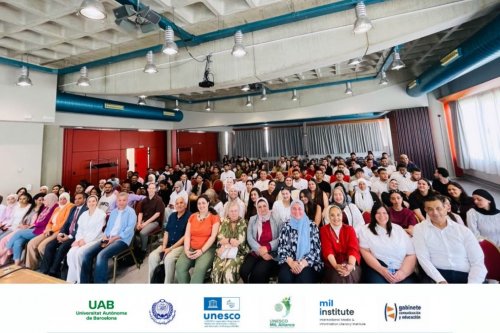
The opening ceremony, held on Tuesday 7 July at the UAB Hotel Campus, brought together more than 300 students, researchers and lecturers from around a dozen countries. Over the next two weeks, participants will take part in an academic programme combining keynote lectures, workshops, case studies and debates organised around three main thematic tracks: MIL and Global Understanding, Law and Rights, and Challenges of Artificial Intelligence.
The ceremony was hosted by environmental journalist Juan David Escorcia and Professor Sally Tayie, Director of the Department of Journalism at the Arab Academy, who welcomed participants and introduced the programme's leading academic representatives.
The programme's Academic Director, Cristina Pulido, opened the institutional addresses by welcoming students and highlighting the importance of beginning the summer within an international learning environment. During her remarks, she emphasised the role of younger generations as key drivers of social transformation and reminded the audience that the university's ultimate mission is to improve people's lives through knowledge, cooperation and a shared commitment to building a fairer future. She also underlined the significance of the programme's core themes as essential tools for addressing the major challenges facing today's global society.
She was followed by José Manuel Pérez Tornero, Programme Director, who reflected on the origins of the collaboration between the UAB and the Arab Academy, established more than three decades ago and strengthened through numerous international academic initiatives. He paid particular tribute to the pioneering role of the Euro-Mediterranean Forum (1995) and stressed the need to reinforce cooperation among Mediterranean countries through the media, critical thinking and intercultural dialogue.
Pérez Tornero also reflected on the complexity of the current international landscape, shaped by armed conflicts, polarisation and disinformation, arguing that intercultural dialogue remains one of the most effective tools for preventing violence. "The worst thing we can do is stop listening to one another and stop recognising one another; that is where violence begins," he told the audience. He encouraged students to imagine new forms of media and new ways of building society, arguing that today's challenge lies not only in developing new technological tools, but also in cultivating a new collective awareness capable of placing those tools at the service of the common good.
Professor Samy Tayie, representing the Rectorate of the Arab Academy, then addressed the audience, highlighting how the MILID Summer School is more relevant than ever in a context characterised by the spread of disinformation and the growing influence of artificial intelligence. He also encouraged students to make the most of the learning opportunities offered by the programme, establish international networks of collaboration and become actively involved in the initiatives promoted by the UNESCO UNITWIN MILID Network and the UNESCO MIL Alliance.
The ceremony also featured presentations by the academic coordinators of the specialised tracks, Carles Górriz (Law) and Pedro Meseguer (Artificial Intelligence), who introduced the main topics to be explored within their respective programmes and presented the international teaching team.
One of the highlights of the opening day was the presentation of the MIL Magazine, a scientific publication promoted by the UNESCO UNITWIN MILID Network with the aim of making research in media and information literacy more accessible to wider audiences.
Cristina Pulido, together with predoctoral researchers Nour Nfissi and María Farré, members of the editorial team, outlined the publication's main areas of work and invited participants to contribute through articles, proposals and science communication initiatives. As Editor-in-Chief of the magazine, Pérez Tornero emphasised the importance of maintaining academic rigour while producing accessible content capable of engaging both the general public and policymakers in the major debates surrounding media and information literacy, artificial intelligence and democracy.
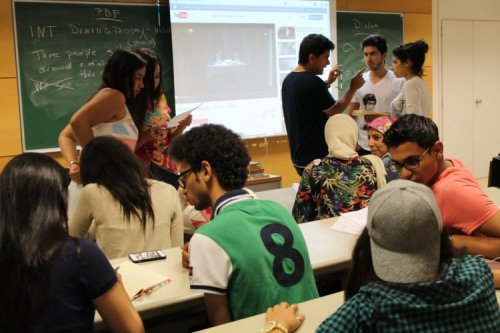
The second half of the ceremony also included the official presentation of the MIL Young Peace Ambassadors initiative, one of the flagship projects of this year's edition. Through audiovisual workshops and participatory activities, students will spend the next two weeks developing awareness campaigns on media and information literacy, intercultural coexistence and peacebuilding. The outcomes of this work will be presented next autumn at the MIL Global Understanding Conference in Cairo.
The opening session concluded with an initial student debate exploring the role of young people in promoting peace, the cultural stereotypes associated with their respective countries, and the contributions they hope to make throughout the programme towards fostering a more critical, open-minded and socially engaged global citizenship.
The Communication and Education Office is a consolidated research group specialising in scientific research and dissemination within the Department of Journalism and Communication Sciences at the Universitat Autònoma de Barcelona (UAB). Recognised by AGAUR (Agency for Management of University and Research Grants of the Government of Catalonia) as a Consolidated Research Group in recognition of its trajectory, impact and development, it carries out research projects at the intersection of communication and education. Since its foundation, the Gabinete has promoted numerous initiatives aimed at integrating communication technologies into the so-called global or knowledge society in a conscious, critical and responsible way. Under the direction of Santiago Tejedor, the Gabinete organises several UAB continuing education master's programmes, including the Master's Degree in Travel Journalism (on-campus and online), the Master's Degree in Communication and Education, the Master's Degree in Environmental Communication, and the Master's Degree in Political and Electoral Communication Management. The group has produced an extensive and continually expanding body of scientific publications, including journal articles, books, book chapters and other research outputs. It also hosts an innovation laboratory dedicated to educational projects, knowledge transfer and the development of new communication formats through creativity and multidisciplinary collaboration. Every year, the Office organises an international academic expedition bringing together students from different universities and disciplines through the Tahina-Can Expedition, recognised as Spain's best educational project. In addition, it develops educational initiatives such as the Tu Aventura portal, the InfoEDU educational platform and the science and newsgames project Reporteros de la Ciencia.