


Languages
- Español
- English
The UAB organises a new edition of the ‘MILID Summer School’
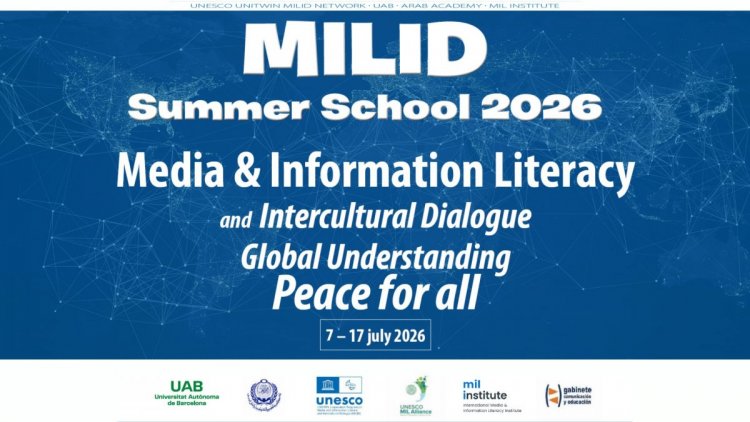
The Communication and Education Office of the Autonomous University of Barcelona (UAB), together with the Arab Academy for Science, Technology and Maritime Transport (AASTMT), the UNESCO UNITWIN MILID Network, the UNESCO MIL Alliance and the MIL Institute, is organising the MILID Summer School 2026, an international programme that will bring together more than 300 students, lecturers and researchers from universities and institutions across the world at the UAB Campus.
Held under the theme "Media & Information Literacy and Intercultural Dialogue: Global Understanding, Peace for All", the event will take place from 7 to 17 July 2026 and will be devoted to exploring the role of Media and Information Literacy (MIL), intercultural dialogue, law and artificial intelligence as essential tools for addressing some of today's most pressing global challenges.
In a context shaped by rapid digital transformation, the rise of artificial intelligence and the growing spread of phenomena such as disinformation, polarisation and hate speech, the Summer School raises a central question: how can media and information literacy, law and artificial intelligence work together to build a fairer, more inclusive society committed to peace?
Over the course of eleven days, the UAB Hotel Campus will host a multidisciplinary programme combining keynote lectures, theoretical sessions, practical workshops, case studies and debates focused on the production of content related to media literacy and digital citizenship. The programme is designed to encourage the exchange of knowledge and experiences between students and international experts.
The academic programme will be organised around three main thematic tracks, which will run in parallel and come together in a series of plenary sessions:
- "MIL and Global Understanding", focusing on media and information literacy, communication and intercultural dialogue as key instruments for building more democratic and peaceful societies.
- "Law and Rights", dedicated to analysing the legal framework that safeguards fundamental rights in the digital environment while addressing the new challenges arising from technological transformation.
- "Challenges of Artificial Intelligence", offering an overview of the foundations, applications, ethical implications and social impact of artificial intelligence and its influence on communication and society.
One of the most significant new features of the 2026 edition will be the MIL Young Peace Ambassadors Programme, an initiative designed to empower young people as active agents in promoting peace, human rights and intercultural understanding. Through audiovisual workshops and collaborative activities, participants will develop media literacy awareness campaigns that will later be presented at the next edition of the MIL Global Understanding Conference, scheduled to take place next autumn in Cairo, Egypt.
The official opening ceremony will take place on Tuesday, 7 July, bringing together representatives from the UAB, UNESCO, the Arab Academy and the MIL Institute. The opening session will include an inaugural lecture together with the presentation of the academic programme and the MIL Young Peace Ambassadors Programme.
Throughout the programme, participants will be guided by an international teaching team comprising researchers and professionals from institutions including the UAB, the University of Salamanca, the University of Toronto, the IIIA-CSIC, the UNESCO MIL Alliance and several universities belonging to the UNESCO UNITWIN MILID Network. The faculty includes renowned specialists such as José Manuel Pérez Tornero, Samy Tayie, Santiago Tejedor, Cristina Pulido, Michele Catanzaro, Félix Ortega, Julian McDougall, Pedro Meseguer, Carles Górriz, Xavier Ortuño, Marta Portalés and María José Recoder, among many others.
With more than fifteen years of history, the MILID Summer School has established itself as one of the leading international initiatives devoted to media and information literacy, critical education and intercultural dialogue, strengthening collaboration between universities, international organisations and research centres committed to fostering a more critical, participatory and responsible global citizenship.
The Communication and Education Office is a consolidated research group specialising in scientific research and dissemination within the Department of Journalism and Communication Sciences at the Universitat Autònoma de Barcelona (UAB). Recognised by AGAUR (Agency for Management of University and Research Grants of the Government of Catalonia) as a Consolidated Research Group in recognition of its trajectory, impact and development, it carries out research projects at the intersection of communication and education. Since its foundation, the Gabinete has promoted numerous initiatives aimed at integrating communication technologies into the so-called global or knowledge society in a conscious, critical and responsible way. Under the direction of Santiago Tejedor, the Gabinete organises several UAB continuing education master's programmes, including the Master's Degree in Travel Journalism (on-campus and online), the Master's Degree in Communication and Education, the Master's Degree in Environmental Communication, and the Master's Degree in Political and Electoral Communication Management. The group has produced an extensive and continually expanding body of scientific publications, including journal articles, books, book chapters and other research outputs. It also hosts an innovation laboratory dedicated to educational projects, knowledge transfer and the development of new communication formats through creativity and multidisciplinary collaboration. Every year, the Office organises an international academic expedition bringing together students from different universities and disciplines through the Tahina-Can Expedition, recognised as Spain's best educational project. In addition, it develops educational initiatives such as the Tu Aventura portal, the InfoEDU educational platform and the science and newsgames project Reporteros de la Ciencia.